
The New Face of Kaizen and Lean: Trending Techniques Reshaping the Future of Work
Kaizen, the Japanese philosophy of continuous improvement, has been quietly transforming workplaces for decades. But in 2026, it looks nothing like it did ten years ago. Driven by artificial intelligence, connected factories, and a growing pressure to do more with less, Kaizen and Lean methodologies have undergone a quiet revolution. The core idea remains unchanged: eliminate waste, improve constantly, and respect the people doing the work. But the tools? They have changed everything.
The Classic Foundation Still Holds
Before diving into what is new, it is worth remembering why Kaizen and Lean have lasted this long. Lean thinking strips away every process step that does not directly add value for the customer. Kaizen takes that further. It says improvement is never finished; there is always something small that can be done better today than yesterday. Together, these two philosophies have helped manufacturers, hospitals, banks, and logistics companies save billions of dollars in wasted time, effort, and resources.
Their staying power does not come from technology. It comes from culture. A team that genuinely believes small, daily improvements matter will outperform a team that only waits for the next big digital investment. That truth is more relevant now than ever.
Digital Kaizen: The Biggest Shift of the Decade
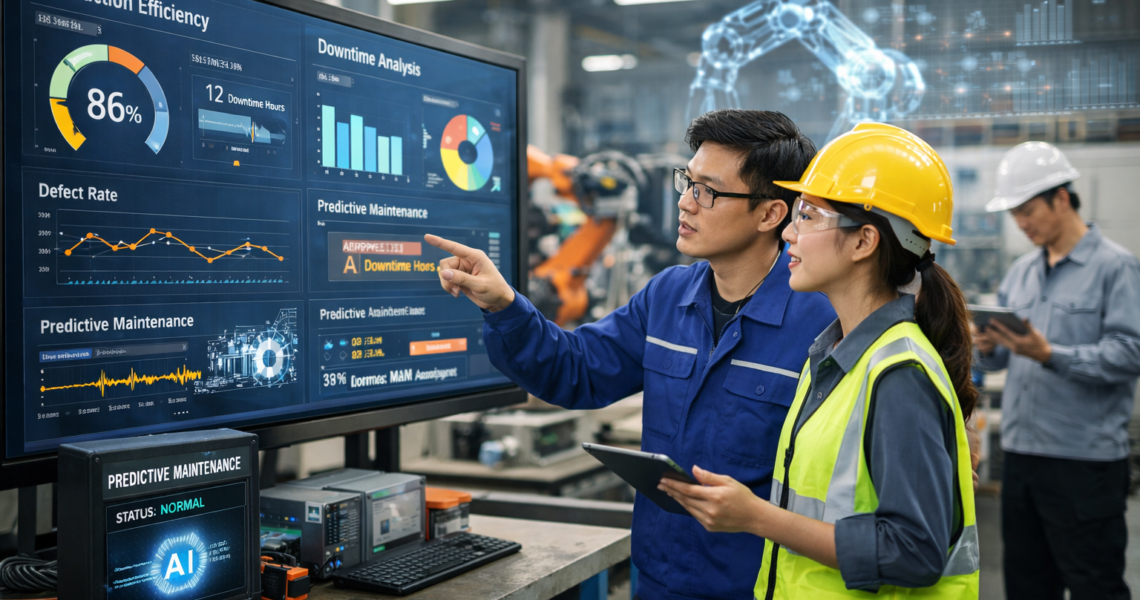
Perhaps the most significant evolution in recent years is what practitioners are calling Digital Kaizen, the blending of traditional continuous improvement thinking with the technologies of Industry 4.0. Picture IoT sensors mounted on a production line feeding live data into an AI-powered dashboard, instantly flagging inefficiencies that a human observer might only notice after weeks of watching. That is what replaces the old clipboard-and-stopwatch approach.
The impact has been measurable. By 2025, roughly 70% of manufacturers had adopted IoT-based monitoring systems, and AI-driven quality control reduced defect rates by up to 30% in early adopters. A traditional Kaizen event might take a full week to diagnose a single problem. Digital Kaizen can surface the same insight in minutes. That is not just faster, it fundamentally changes how improvement happens.
AI and Predictive Maintenance: Lean Gets Smarter
One of the most practical modern applications of Lean thinking is predictive maintenance powered by AI and industrial IoT sensors. For decades, factories operated reactively, machines broke, work stopped, engineers scrambled. Lean pushed companies toward preventive schedules. Now, AI goes one step further by predicting failure before it happens.
One real-world example says it all: an automotive parts supplier used an AI system that detected a motor bearing degradation pattern a full 14 days before failure. The team replaced it during a planned shift change, avoiding 48 hours of unplanned downtime and saving an estimated $120,000 in lost production. Across the industry, predictive maintenance programs have been shown to cut downtime by up to 50% and reduce maintenance costs by 40%. For any lean practitioner, that kind of preventable waste disappearing from the equation is as good as it gets.
Lean 4.0: The Smart Factory Revolution
Lean 4.0 is the convergence of proven lean principles with modern digital infrastructure, cloud platforms, digital twins, smart sensors, and real-time analytics working together. Where a traditional manufacturer relied on manual value stream maps drawn on paper, a Lean 4.0 operation simulates the entire production flow digitally before making a single physical change. Where defect tracking was once reactive, AI now flags anomalies the moment they appear.
Smart factories built on this foundation have reported up to 50% reductions in unplanned downtime. It is worth being clear: Lean 4.0 is not a replacement for classic lean thinking. It is an amplifier. The discipline of identifying waste, standardising processes, and empowering workers remains exactly the same. What changes is the quality of information people are working with.
The Agile-Lean Hybrid: When Speed Matters As Much As Efficiency
Manufacturing is not the only world being reshaped. In software development, healthcare, financial services, and logistics, a powerful hybrid approach is gaining serious ground, one that combines Lean’s waste-elimination discipline with Agile’s sprint-based flexibility.
Traditional lean was occasionally criticised for being too focused on process stability in environments that change faster than any standard can keep up with. The Agile-Lean hybrid addresses this directly. Teams run short improvement sprints, gather rapid feedback from real outcomes, and adjust quickly, while never losing sight of the fundamental lean goal of cutting waste and delivering value. It is a model that is both rigorous and nimble, which is exactly what the current business environment demands.
Supply Chain Kaizen: Improvement Beyond the Factory Gate
Modern lean no longer stops at the factory wall. Supply Chain Kaizen takes continuous improvement and extends it across the entire value network, from the raw material supplier at one end to the customer’s doorstep at the other. Organisations are now sharing real-time performance data with their suppliers, setting joint improvement targets, and treating external partners as genuine members of the Kaizen loop rather than vendors to be managed from a distance.
This shift matters enormously after several years of global supply chain disruption. Resilience has moved from a talking point to a strategic necessity. Companies that apply lean thinking across their whole supply chain, not just their own operations, are the ones building the kind of flexibility that weathers volatility.
Digital Kaizen for SMEs: The Playing Field Levels Out
For years, small and medium-sized enterprises (SMEs) watched the digital transformation wave from the sidelines. The tools cost too much, required too much technical expertise, or simply were not designed with smaller businesses in mind. That barrier is now genuinely breaking down.
In 2025, the Asian Productivity Organization (APO) launched a dedicated training programme on Digital Kaizen specifically for SMEs, recognising that affordable cloud tools, mobile analytics platforms, and accessible AI have finally brought data-driven continuous improvement within reach of businesses that cannot afford a full digital transformation budget. This democratisation is arguably one of the most important shifts in the Kaizen world right now. Continuous improvement has never belonged only to large corporations, and the tools are finally catching up to that reality.
Kakushin: When Incremental Improvement Is Not Enough
There is a concept sitting quietly alongside Kaizen that deserves more attention: Kakushin, a Japanese word meaning radical innovation. Where Kaizen asks “how do we do this better?”, Kakushin asks “should we be doing this at all?”. The two are not in competition, they are complementary.
The most forward-thinking organisations blend both. Kaizen drives steady, disciplined, daily improvement. Kakushin triggers when the process itself is fundamentally broken, outdated, or simply wrong for the current reality. Knowing when to apply which approach is becoming one of the most valuable leadership skills in operations management.
Energy Value Stream Mapping: A New Frontier
One of the more unexpected developments in modern lean is its application to energy efficiency. Lean tools like value stream mapping are now being applied to energy flows across a facility, creating what practitioners call “energy value stream maps.” A textile factory used this approach to identify that 40% of its compressed air energy was being lost through leaks and inefficient use. By running targeted Kaizen events to fix those leaks and install variable-speed drives, the factory cut its energy-related carbon footprint by 25% annually. Lean is no longer just about time and materials, it is increasingly a sustainability tool as well.
Culture Remains the Foundation
With all the talk of AI, digital twins, and smart sensors, it is easy to assume technology is now doing the heavy lifting in continuous improvement. Every experienced practitioner will push back on that. Frontline ownership, daily discipline, and genuine leadership engagement remain the irreplaceable core of any Kaizen culture.
Digital tools amplify positive culture. They cannot create it. The organisations getting the most out of modern Lean and Kaizen are the ones that combine real-time data with real human engagement, visual management boards that teams actually use, leaders who walk the floor every day out of genuine curiosity rather than inspection, and workers who feel safe raising problems before they become crises.
Improvement, in the end, is still a deeply human endeavour. The technology just makes the path clearer.
Sources: Kaizen Institute Global Manufacturing Trends 2026 | Asian Productivity Organisation | Manufacture Now Lean Trends 2026 | AIRAC Lean Manufacturing Digital Trends | Global Trade Magazine Kaizen in Logistics 2025