
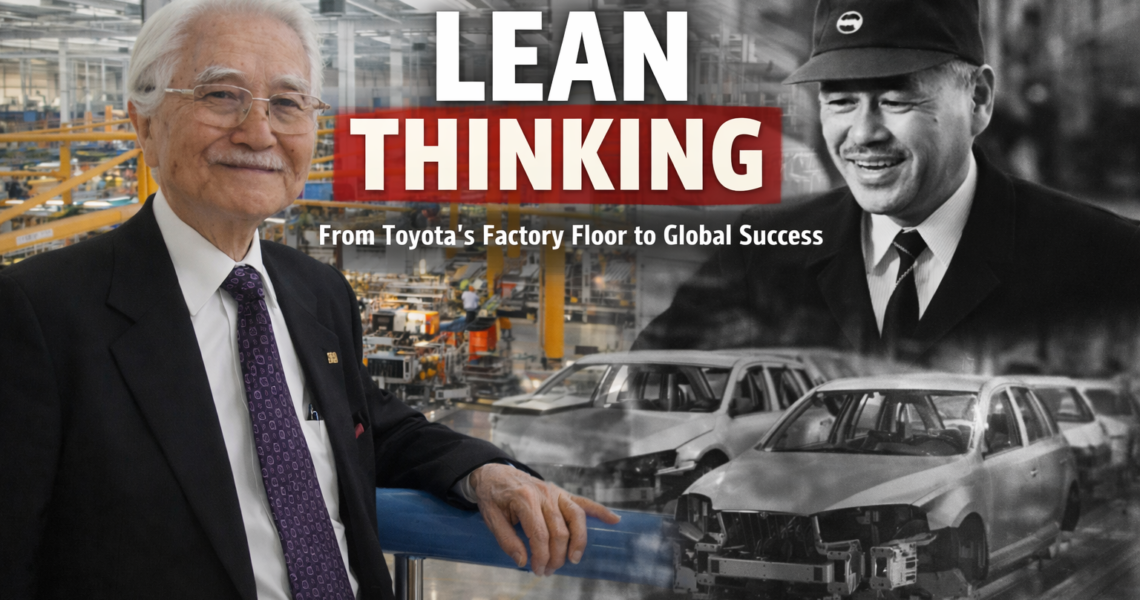
Lean Thinking Is Built on Discipline, Not Fashion
Why the pioneers of Lean continue to influence how serious organisations compete
Management history is full of movements that arrive with energy and fade with equal speed. Lean, however, has endured for more than seven decades. Its longevity is not accidental. It survives because it addresses something fundamental: how work flows, how problems are solved, and how leaders behave under pressure.
Lean did not begin as a corporate initiative. It began as a response to constraint. In post-war Japan, resources were scarce and survival demanded ingenuity. Within that context, Taiichi Ohno began challenging assumptions embedded in traditional mass production. Large batches and heavy inventory, he observed, created the illusion of productivity while hiding inefficiencies. If materials were piling up between processes, something was wrong. If defects were discovered late, something had been ignored earlier.
Ohno’s contribution was not merely technical. He reframed efficiency as the steady removal of waste. Producing only what was needed, when it was needed, and in the quantity required was not a slogan; it was a discipline. Flow mattered. Interruptions revealed weaknesses. Waiting time exposed imbalance.
Alongside him, Shigeo Shingo sharpened the system’s technical edge. He focused on reducing setup times that had long been considered unavoidable. Through systematic experimentation, he proved that hours-long changeovers could be reduced dramatically. His work on mistake-proofing reinforced a central Lean principle: quality should be built into the process, not inspected at the end. If errors recur, the system is speaking. Leaders must listen.
The institutional backing of Eiji Toyoda ensured that these ideas became cultural norms rather than isolated improvements. Lean was not allowed to remain a collection of experiments; it became the operating backbone of Toyota. The philosophical roots, however, stretch even further back. Sakichi Toyoda introduced the concept of Jidoka, the idea that machines should stop automatically when abnormalities occur. This simple principle embedded responsibility into the production system. His son, Kiichiro Toyoda, reinforced the conviction that production must align closely with real customer demand.
The wider world came to understand this system through the research of James P. Womack and Daniel T. Jones, who described Toyota’s approach as “Lean” in 1990. Their work highlighted that what differentiated high-performing organisations was not scale alone, but a relentless focus on value and flow.
Over time, Lean travelled beyond automotive manufacturing. Hospitals applied its methods to reduce patient waiting times. Banks used it to streamline transaction processing. Logistics firms used it to stabilise supply chains. Yet as Lean spread, misinterpretation followed. In some organisations, it became synonymous with cost reduction or short-term productivity drives. Visual boards appeared. Workshops were conducted. Terminology was adopted. But without consistent leadership behaviour and daily problem-solving routines, improvements proved fragile.
The pioneers of Lean never presented it as a quick fix. They emphasised observation at the workplace, structured experimentation, and respect for frontline knowledge. Lean requires leaders to ask questions rather than issue instructions. It requires teams to confront problems openly rather than conceal them behind excess inventory or overtime.
In the current era of digital transformation, Lean’s relevance has arguably increased. Automation can accelerate throughput, but it cannot correct instability in upstream processes. Data analytics can reveal patterns, but they cannot replace disciplined thinking on the ground. When technology is layered onto weak systems, inefficiency merely moves faster.
Lean’s endurance lies in its simplicity. It insists that organisations stabilise before they scale. It encourages clarity before complexity. It demands that improvement be continuous, not episodic.
For companies seeking resilience amid volatility, the lesson remains clear. Lean is not a toolkit to deploy during difficult quarters. It is a long-term commitment to designing systems that expose problems early, empower people to solve them, and align effort with genuine customer value.
The pioneers who shaped Lean were not chasing recognition. They were solving practical problems under real constraints. That practicality explains why, decades later, their thinking continues to guide organisations determined to compete with discipline rather than noise.