
The Wartime Training Method Quietly Powering Today’s Lean Factories
On factory floors, a training method born inside the United States War Department in the 1940s is once again teaching supervisors how to cut defects, raise output and keep their best people. It is called Training Within Industry, or TWI, and after eight decades, its ideas still feel surprisingly modern.
When France fell in the summer of 1940, American industry faced an emergency. Skilled workers were being drafted into the military just as Washington was placing massive orders for tanks, ships and aircraft. The National Defense Advisory Commission set up the TWI Service in August 1940, and by the time it closed in the fall of 1945, more than 1.6 million workers in over 16,500 plants had been certified through its programmes, according to the official TWI Report archived by the U.S. Government Publishing Office (GovInfo).
The architects of the programme, a group of industrial veterans later nicknamed the Four Horsemen, distilled supervision into three short courses, each ten hours long and delivered in five two-hour sessions. They became known simply as the J programmes: Job Instruction, Job Methods and Job Relations. A fourth, Program Development, was added for internal trainers (Wikipedia).
After the war, TWI was carried into Japan as part of the post-war reconstruction effort. Toyota absorbed it deeply, and many lean practitioners now regard the J programmes as the missing human layer beneath the more famous tools of the Toyota Production System.
What the three modules actually do
Job Instruction, or JI, teaches a supervisor how to train an operator so the job is done correctly, safely and conscientiously. The trainer breaks the work into important steps, key points and reasons, then follows a four-step pattern: prepare the worker, present the operation, try out performance and follow up. It sounds simple, but it kills the habit of telling a new hire to “watch Ramesh for a week and you will pick it up.”
Job Methods, or JM, gives supervisors a structured way to improve the work itself. Each step of a job is questioned with a disciplined sequence of why, what, where, when, who and how, and then ideas are eliminated, combined, rearranged or simplified. This is the original kaizen worksheet, drafted long before the word kaizen entered English.
Job Relations, or JR, is the part most companies skip and most regret skipping. It treats people problems as preventable production problems. Supervisors are trained to know each worker as an individual, to give credit when due, to inform people in advance of changes, and to make best use of ability. When trouble surfaces, they follow four steps: get the facts, weigh and decide, take action and check results.
Why the method still works
Recent evidence suggests the wartime gains were not a fluke. A 2022 study published in the Journal of Political Economy tracked all 11,575 U.S. firms that applied to the TWI programme. It found that productivity at trained firms rose 6 percent within a year and 27 percent after a decade, with positive spillovers to suppliers and customers (PMC).
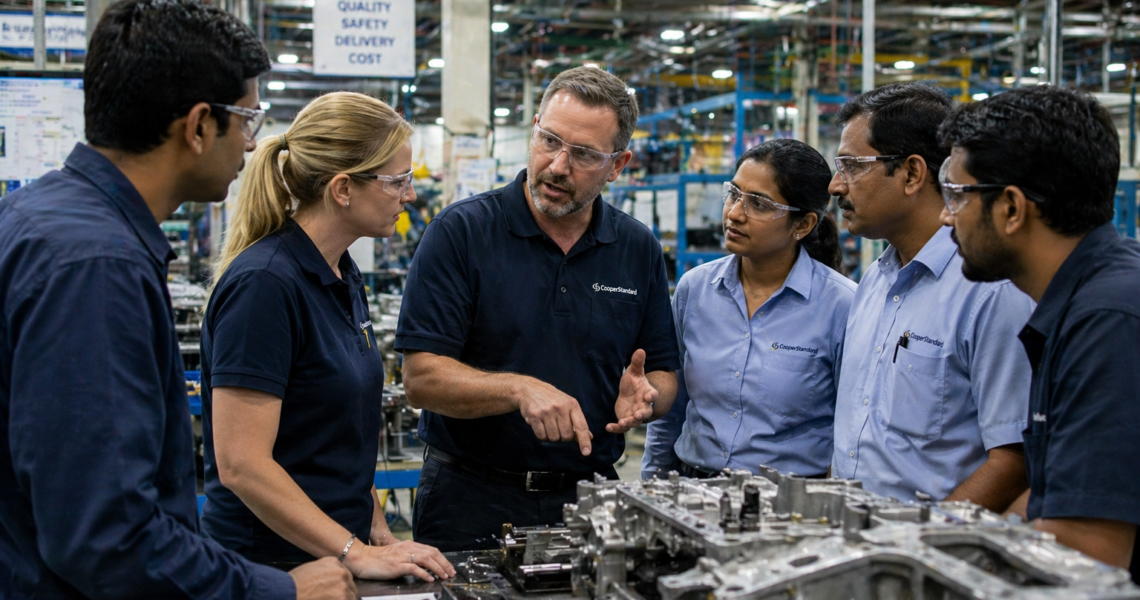
Modern adopters report similar numbers. Cooper Standard Automotive, working across 20 European plants, raised labour productivity by an average of 17.55 percent and cut defects by 35.83 percent after deploying TWI (LeanTrix). The Supervisor Academy, reviewing more than 600 case studies, says it is common for committed adopters to see improvements of 50 percent or more in target metrics (Supervisor Academy).
How to roll it out
A practical sequence works best for plants in India and across Asia.
Begin with Job Relations. Supervisors who do not have the trust of their teams cannot teach standard work, no matter how good their breakdowns are. Run the ten-hour JR course for every front-line and middle manager.
Next, write Job Breakdown Sheets for the top 20 percent of operations that drive 80 percent of safety, quality or output risk. Keep each sheet to important steps, key points and reasons. Avoid bloated SOPs that nobody reads.
Then deliver Job Instruction. Certify a small number of internal trainers first, let them train supervisors, and let supervisors train operators. Audit the four-step method on the shop floor weekly for the first quarter. Skill comes from repetition, not slides.
Bring in Job Methods last, once standards are stable. There is no point improving a method that is not yet being followed.
Connect the whole effort to a daily management routine. A short morning huddle in front of a board that tracks safety, quality, delivery and people issues turns TWI from a training event into a habit.
A reminder from the lean world
John Shook, a senior advisor at the Lean Enterprise Institute and one of the first Americans to work inside Toyota, captured the point in a single line.
“I like to say that the Toyota Way is a socio-technical system on steroids. A test for all our lean systems is the question of how well we integrate people with process. Nowhere does that come together more than in the form of standardized work and kaizen,” he wrote (Lean Enterprise Institute).
That, in the end, is the quiet promise of TWI. Tools alone will not save a factory. A trained supervisor, who can teach a job, improve a method and lead a team, almost always will.