
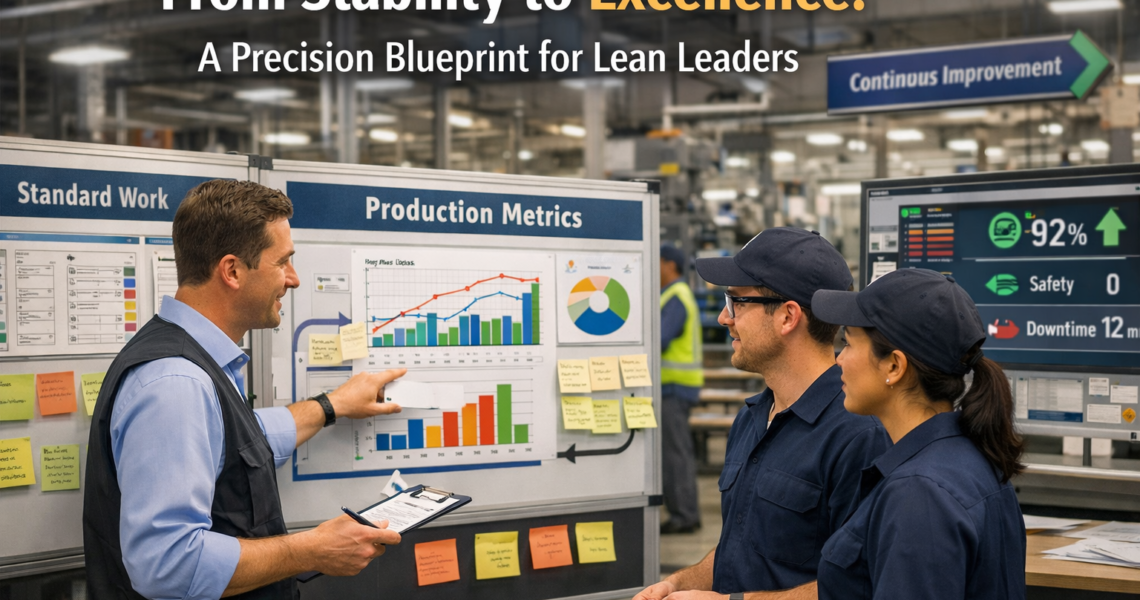
From Stability to Excellence: A Precision Blueprint for Lean Leaders
Most Lean transformations fail not in the conference room but on the shop floor, not because the strategy was wrong but because the discipline to execute it consistently was absent. Sustainable manufacturing excellence is not a destination reached through sporadic improvement events or technology investments alone. It demands something far more rigorous: daily process control, unyielding operational discipline, and relentless continuous improvement woven into the fabric of every shift, every line, every decision.
The Architecture Beneath Excellence
Before any organization can talk about optimization, it must be honest about its foundation. The Architecture of Excellence is built in three ascending layers: a base of Standardization, a core of Process Control and Deviation Management, and an apex of Optimization and Continuous Improvement. What drives the structure upward is not ambition, it is the PDCA loop functioning as a continuous kinetic engine, cycling learning into action and action into elevated standards.
This architecture matters because excellence is not a static peak. It is an expanding loop. Organizations that attempt to leapfrog the base and land at the apex, deploying Industry 4.0 machines without first maturing their methods and manpower, do not accelerate excellence; they create expensive bottlenecks. The sequence is non-negotiable.
The Three Pillars That Carry the Weight
Baseline Standardization is where operational integrity begins. Standard Work Routines define the exact sequence and timing of activities, visual controls make the standard visible and anomalies immediately detectable, and the Manufacturing Operations Manual serves as the immutable playbook for execution. Without a predictable baseline, organizations cannot measure accurately, cannot improve reliably, and cannot prevent operational backsliding.
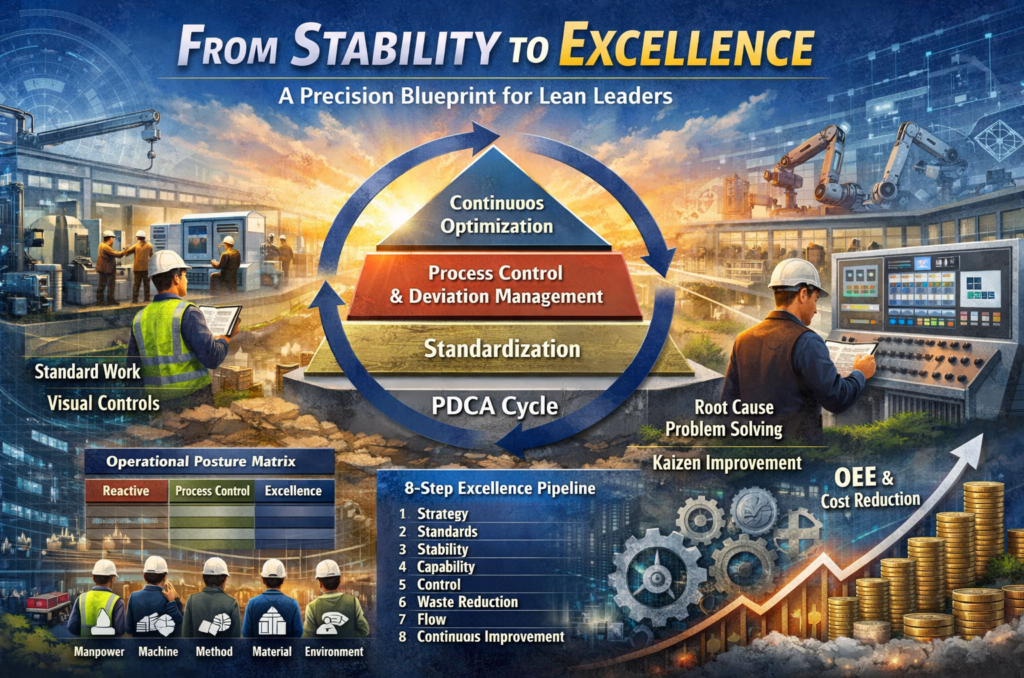
The second pillar, deviation management, is where most organizations expose their true operational posture. System degradation is inevitable when deviations are tolerated rather than eradicated. A robust deviation cycle moves rapidly through three stages: Detect anomalies in real time through visual controls, Contain the fracture immediately through layered audits to protect throughput, and Eradicate the root cause permanently through structured problem-solving. The difference between a capable operation and a firefighting operation lives entirely in how quickly and decisively this cycle runs.
Continuous Optimization is the third pillar and it is only credible when built on the first two. Value Stream Mapping eliminates cross-functional flow disruptions. Jishuken workshops unleash self-directed, immediate-action waste elimination from the workforce. Predictive analytics transition the organization from reactive response to algorithmic prevention. Optimization without stability is noise. Optimization on a stable foundation is competitive leverage.
Diagnosing Where You Stand
The Operational Posture Matrix is a frank diagnostic for leaders willing to be honest about their current state. Organizations in Reactive Management mode rely on tribal knowledge, fight fires at the point of defect, and manage through top-down directives. Those in Process Control mode have real-time dashboards, execute Standard Work, and produce stable, predictable throughput. Manufacturing Excellence organizations operate with predictive analytics, high-engagement Kaizen culture, and margin-expanding output. Most manufacturing organizations, if honest, sit between the first and second columns, capable of more, yet anchored by undisciplined execution.
The Pipeline and the System
The 8-Step Excellence Pipeline codifies the maturity sequence: Strategy alignment, Standards implementation, Stability, Capability, Control, Waste Reduction, Flow Optimization, and finally, Continuous Excellence. Attempting to optimize flow at Step 7 without first securing stability at Step 3 guarantees systemic failure, a principle violated in nearly every rushed transformation.
Equally important is the 4Ms+E System Radar, which recognizes that isolated upgrades generate zero systemic return. Manpower, Machine, Method, Material, and Environment are interlocking nodes. Improving one while neglecting others creates imbalance, not progress. True manufacturing excellence emerges only when all five dimensions advance in concert.
Excellence Is a Financial Imperative
Shop floor management is not a cost center, it is a margin-protection engine. Disciplined standardization and deviation management directly drive OEE by expanding capacity utilization without capital expenditure. Root-cause eradication slashes the Cost of Poor Quality, stopping profit leakage at the source. Value stream design converts static work-in-progress into realized cash flow through accelerated inventory turns and throughput yield.
The final truth that every Lean leader must internalize is this: strategy without execution discipline is organizational theater. The organizations that win in manufacturing are not those with the most sophisticated tools, they are the ones with leaders disciplined enough to hold the standard on Tuesday morning when no one is watching and humble enough to ask why the process deviated before asking who failed. Execution is the ultimate strategy.
Source: Fundamentals of daily shop floor management by Philip J. Gisi