
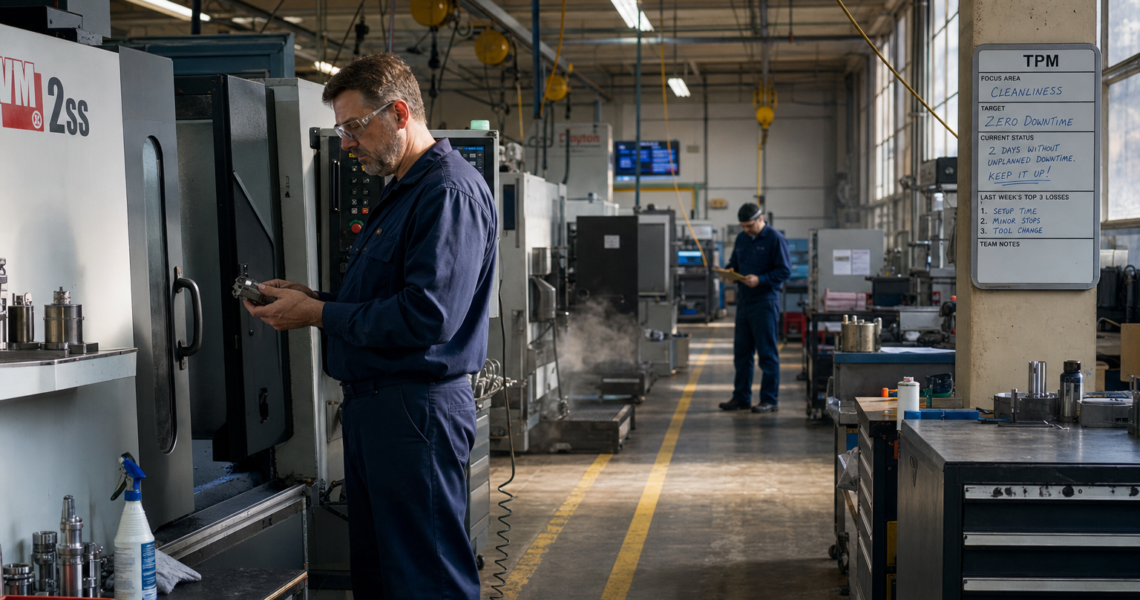
The 7M Process Assessment: Why Most Operational Problems Are Hiding in Plain Sight
Walk into any factory on a difficult morning and you’ll hear the same conversation. A line is down, a customer is escalating, a shipment is at risk, and somewhere near the machine three people are pointing at a fourth one who isn’t in the room. The plant head wants answers in fifteen minutes. The quality manager is already drafting a containment note. And the operator, the one who actually saw what happened, is quietly waiting for someone to ask.
This is where most operational problems begin. Not in the breakdown itself, but in how we look at it.
After years of walking shop floors across industries, one pattern repeats almost everywhere. The visible problem is rarely the real problem. A defect is almost never just a defect. A breakdown is almost never just a breakdown. What we see on the surface is the final symptom of something that has been quietly drifting for weeks, sometimes months, across several parts of the system. This is exactly why the 7M Process Assessment matters, and why I keep coming back to it.
The seven places where problems actually live
The 7M framework looks at any process through seven lenses: Man, Machine, Material, Method, Measurement, Mother Nature, and Maintenance. On paper it sounds like a checklist. In practice, it’s something closer to a habit of looking. A way of refusing to accept the first explanation.
Man is rarely about blame, even though that’s where most investigations begin. It’s about competency, training depth, fatigue, handover quality, and whether the operator has actually been shown the right way or simply told about it. There’s a difference, and the shop floor knows it.
Machine is where overconfidence lives. We assume a machine that is running is a machine that is performing. It isn’t always true. Cycle times drift. Sensors lose sensitivity. A spindle that sounds fine to a manager sounds wrong to the operator who has stood next to it for three years.
Material problems quietly travel through the supply chain long before they show up as rejections. Mixed batches, expired adhesives, moisture affected components, supplier substitutions that nobody flagged. These don’t fail loudly. They fail later, on the customer’s line.
Method is the SOP question. Is the documented method the actual method? In most plants, honestly, no. Operators have improved the process informally, or worked around a broken step, or developed shortcuts that work most of the time. Until they don’t.
Measurement is the silent killer. Uncalibrated gauges. Inconsistent inspection frequency. Two inspectors interpreting the same specification differently. You can’t improve what you can’t measure correctly, and most plants measure with more confidence than accuracy.
Mother Nature, the environment, is the category leaders forget. Humidity, temperature, dust, vibration, lighting. These don’t appear in the FMEA but they appear in the reject bin.
Maintenance is where the firefighting versus prevention culture shows itself most clearly. TPM on the wall is not TPM on the machine. Preventive maintenance done on paper is not preventive maintenance done in reality.
Why we keep missing it
Leadership tends to focus on what is visible, urgent, and easy to assign. A bad part, a late shipment, a customer complaint. The 7M assessment forces a slower, harder conversation: what in our system allowed this to happen, and what else is it quietly affecting? Most organizations don’t avoid root cause analysis because they don’t believe in it. They avoid it because honest root causes are uncomfortable. They point at decisions, not just people.
A case from the floor
A mid sized auto component plant I worked with was losing roughly 6% of monthly output to a recurring surface defect on a machined housing. Customer complaints had crossed the line from polite to serious. Leadership was convinced it was an operator handling issue, specifically on the second shift where most rejections appeared. The proposed fix was retraining and a warning memo.
We ran a 7M assessment instead.
Under Man, second shift operators were indeed less experienced, but the handover from first shift was the real gap. Informal, verbal, no written log of process adjustments made during the day. Under Machine, the coolant pressure on one of the two CNCs had dropped about 12% over six months; nobody had noticed because the machine “ran fine.” Under Material, the raw casting supplier had silently changed a sub vendor three months earlier, and hardness variation had increased. Under Method, the SOP still referenced an older fixture that had been replaced fourteen months ago. Under Measurement, the surface roughness gauge was overdue for calibration by nine months. Under Mother Nature, the second shift coincided with the warmest part of the day in a non air conditioned bay, and thermal expansion was nudging tolerances. Under Maintenance, the PM schedule existed but the last three cycles had been signed off without actually being performed.
No single cause. Seven small drifts, stacked.
The corrections were unglamorous. A structured shift handover log, coolant system overhaul, supplier requalification, SOP rewrite with the current fixture, gauge recalibration cycle, exhaust ventilation in the bay, and a TPM audit with teeth. Within three months, the defect rate dropped from 6% to under 0.8%. Unplanned downtime on those CNCs fell by roughly 40%. The second shift, the one that had been blamed, became the better performing shift.
The honest conclusion
Sustainable operational excellence doesn’t come from heroic recoveries or louder accountability meetings. It comes from disciplined systems, honest observation, and a culture that is more interested in understanding than in assigning. The 7M assessment is not a tool you use once during a crisis. It’s a way of looking at your own operation with the humility to assume that something, somewhere, is already drifting, and the discipline to find it before the customer does.
The best plants I’ve seen are not the ones without problems. They’re the ones that see problems earlier, talk about them honestly, and fix the system rather than the symptom.
That, more than any tool, is what Lean really is.