
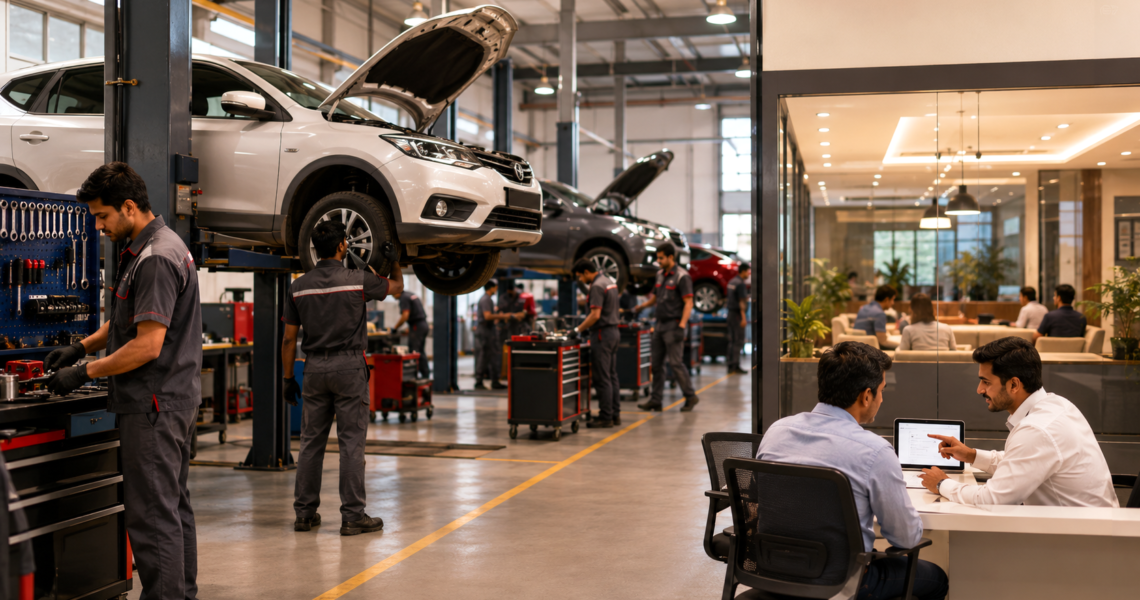
Indian auto dealers turn to lean methods to cut chaos and win back trust
Indian vehicle dealerships and service centres are adopting lean management techniques to tackle chronic delays, rework and customer dissatisfaction, aiming to bring factory-style discipline to noisy, overbooked workshops and crowded showrooms.
For many dealer principals and service heads, the scene is familiar: bays are full, phones ring constantly, staff move at speed – yet customers still complain about long waiting times, unclear updates and repeat visits for the same issue. Activity is high, but reliability is low.
Lean management, adapted from manufacturing, focuses on removing waste, smoothing workflow and aligning daily decisions with a clear long-term direction. Applied to dealerships, it aims to restore control in environments where demand is volatile and customer expectations are rising.
Defining a clear “True North”
The starting point is a concise statement of what “ideal” performance should look like for customers and employees. For a dealer and service centre, leaders typically frame this “True North” around three themes: jobs done right the first time and on time, transparent communication with customers, and a safe, respectful workplace for staff.
Such statements are framed not as slogans but as decision rules. When a service advisor must choose between squeezing in one more car or protecting commitments already made, the True North standard pushes the decision towards reliability rather than volume. When management weighs a short-term discount campaign against potential pressure on service capacity, the same lens applies.
Viewing operations as a customer journey
Traditional dealer structures are built around departments – sales, service, body shop, spares and accounts. Customers, however, experience a continuous journey from enquiry or booking to final handover.
Lean programmes begin by mapping this end-to-end journey. Teams document each step, wait, handover and approval from the customer’s perspective, along with the time involved. A common finding is that vehicles spend a large share of their time idle: waiting for bay allocation, technical assessment, parts, washing or billing.
This exercise typically reveals that the main constraint is not staff effort but systemic waiting, rework and confusion. It provides the baseline for redesigning processes to allow vehicles and information to move more smoothly.
Managing workshop flow
In service operations, time and trust are the primary products. Lean methods focus on aligning bookings with real capacity, separating different types of work and defining clear physical routes for vehicles.
At the planning level, dealers move away from accepting all bookings and instead build realistic daily capacity plans by bay and technician. This stabilises workloads, reduces last-minute promises and improves the accuracy of delivery commitments.
Operationally, routine services and small jobs are often moved into fast-track lanes with standardised procedures, while complex diagnostics and accident repairs follow separate paths. This prevents difficult cases from blocking simpler work and reduces variability in lead times.
Dealers also define standard parking and movement patterns: where cars wait before assessment, where they go after repair, and how they move to washing and delivery zones. With clear visual cues, staff can see the status of each vehicle at a glance, limiting informal tracking and repeated status checks.
Using workplace organisation to expose problems
Many workshops have run short-lived cleanliness campaigns. Under lean, workplace organisation is formalised through 5S – sorting, setting in order, cleaning, standardising and sustaining.
Unnecessary tools, jigs and spare items are removed to free space and reduce search time. Frequently used tools and equipment are placed close to their point of use with fixed, labelled locations. Regular cleaning is used to detect leaks, wear or damage early, rather than for appearance alone.
Simple visual standards define what a ready bay, parts store or washing area should look like. Deviations become easy to spot, helping supervisors and technicians identify issues before they affect customers.
Standardising work without removing judgement
Variation in how technicians and sales staff handle common tasks is a major source of inconsistency. Lean programmes respond with “standard work”: the best-known method for performing a job at the current level of knowledge.
In service, this can include checklists for standard services, diagnostic paths for recurring complaints, rules for seeking customer approval and fixed sequences for vehicle reception and handover. In sales, standards may cover response times for leads, steps in a test drive and delivery protocols.
Standard work is positioned as a baseline, not a constraint. Staff are encouraged to suggest improvements, which are tested and, if successful, incorporated into the standard. This approach supports training, stabilises quality and creates a platform for continuous improvement.
Embedding daily management routines
Lean becomes durable when it is embedded into daily management rather than treated as a project. Many dealers introduce short shift-start meetings at team boards in service and sales. Teams review the previous day’s performance, the current day’s load and any vehicles or customers at risk, and agree on one or two small actions.
Simple visual boards display indicators such as safety incidents, rework cases, on-time delivery, ageing jobs and complaints. These boards are updated by the teams themselves and used as discussion tools, not for one-way reporting.
Leaders conduct regular on-site walks through workshops and customer-facing areas. The focus is on understanding obstacles, listening to staff and supporting problem-solving, rather than fault-finding. This visibility and support are critical for sustaining new practices.
Linking sales, service and digital interfaces
Customer journeys now span showrooms, service desks, call centres, websites and messaging platforms. Lean implementations seek to integrate these touchpoints.
Information about customer history, prior complaints and promises made at the time of sale is shared with service teams to reduce misunderstandings. Live status on bookings, vehicle progress and parts availability is made visible internally and, where feasible, to customers.
Feedback from service – including patterns of usage, frequent questions and recurring issues – is routed back to sales and marketing, helping refine how features are explained and expectations are set.
Pilot first, scale later
Many dealers are tempted to announce network-wide lean programmes. Practitioners typically advise starting smaller, selecting one branch or a clearly defined process such as periodic maintenance for a pilot.
Within that scope, teams define their True North, map the current journey, redesign for smoother flow, and implement 5S, standard work, visual management and daily routines. Leaders are coached to support the change and remove barriers.
After three to six months, results in lead times, rework rates, staff turnover and customer feedback provide evidence for further investment. Lessons from the pilot inform a structured rollout to other branches or value streams, reducing the risk of superficial adoption.
Call to action for dealer and service leaders
Indian dealer and service leaders facing rising customer expectations and margin pressure are under pressure to stabilise operations without dampening growth. Lean offers a way to reduce firefighting, improve reliability and build long-term trust.
A practical starting point is to select one area, define a simple True North, map the existing customer journey and commit to three months of disciplined daily management. From there, data and experience can guide broader implementation.
If you are responsible for dealership or service performance and recognise recurring chaos despite strong effort from your teams, the next step is to move from coping with problems to redesigning the work itself. Lean provides a tested framework to do that systematically.