
The Waste We See Is Rarely the Problem We Need to Solve
Find the waste and remove it. Teams map unnecessary movement, waiting, defects, excess inventory, and repeated approvals. These observations are valuable, but they can point us towards the wrong conclusion. Waste is visible, so it receives attention. The conditions that produced it often remain untouched.
This is why the Lean concept of the three Ms, Muda, Mura, and Muri, deserves attention.
“Muda” means waste: activity that consumes time, effort, or resources without creating value. “Mura” means unevenness: unstable demand, irregular workloads, inconsistent quality, or schedules that move between silence and crisis. “Muri” means overburden: asking people, equipment, or processes to operate beyond a reasonable capacity.
The relationship is causal. Mura often creates Muri, and Muri produces Muda. An unstable schedule creates pressure. Pressure overloads people and machines. Overload leads to mistakes, breakdowns, delays, and rework. Managers then attack the visible waste while leaving the unstable schedule unchanged. The organization becomes better at treating symptoms but no better at preventing them.
“Waste is often the footprint left behind by variation and overburden.”
A factory that blamed speed
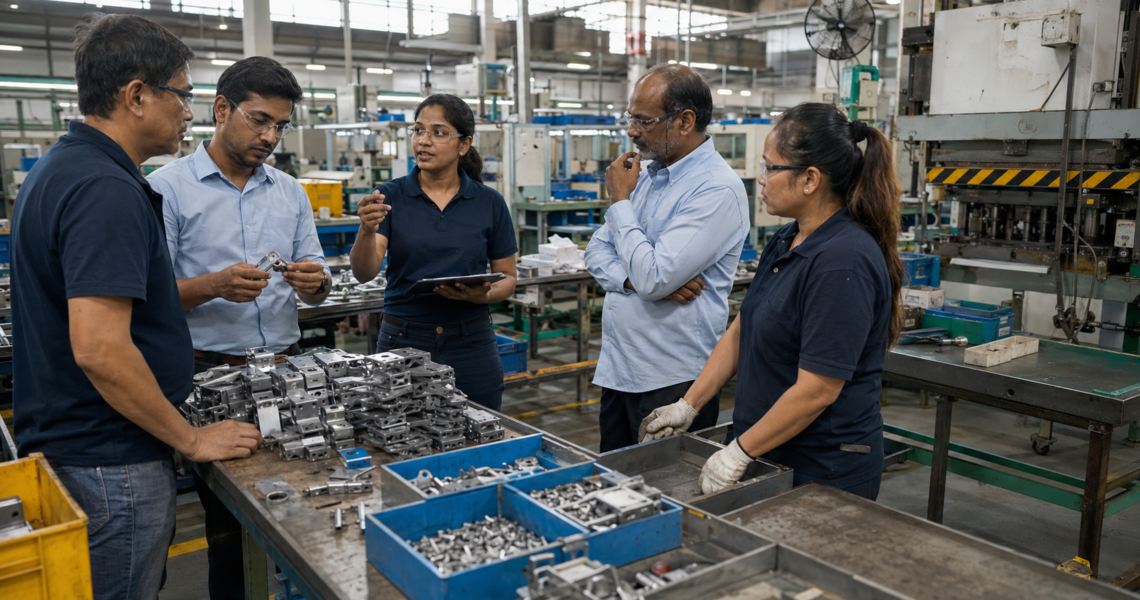
Consider a composite case from a components factory. The final assembly area regularly missed its production target. Supervisors believed the problem was operator speed because unfinished units accumulated near the end of each shift. Overtime became normal, inspections found more defects, and employees were reminded to work faster.
A closer study revealed a different story. Customer orders were released in large, irregular batches. On some mornings, assembly workers waited for parts. Later, several batches arrived together, and the team was expected to recover output before the shift ended. The workstations were unbalanced: one operation required nearly twice as long as the others. What appeared to be low productivity was Mura creating Muri and eventually Muda.
The company changed the system before judging the people. Orders were leveled into smaller daily quantities. Material delivery was scheduled at fixed intervals. Tasks were redistributed to balance workstation times, and visual checks showed whether the process was drifting from plan. Managers introduced conversations in which operators could flag overload, missing material, or abnormal work without being blamed.
Within eight weeks, overtime fell, work in progress reduced, and first-pass quality improved. The largest change was cultural. People stopped hiding problems until the end of the shift. The factory had not discovered a faster workforce; it had created a steadier system in which the workforce could perform well.
“Burnout is not proof that people are weak; it is evidence that the system is asking for more than it can sustainably support.”
What is the process telling us?
This distinction matters because overburden is often misread as an individual failure. When someone falls behind, makes repeated errors, or withdraws from improvement discussions, the easiest explanation is attitude. A better manager asks what the process is communicating. Is demand arriving unevenly? Are priorities constantly changing? Is standard work realistic? Is staffing based on average demand while peaks are treated as personal emergencies? Are machines being run without adequate maintenance because the target leaves no room to stop?
Quality management is not about catching people doing something wrong. It is about designing work so that doing the right thing is clear, possible, and repeatable. Checklists and audits help, but they cannot compensate for impossible workloads or unstable planning. Sustainable quality comes from honest capacity, predictable flow, sensible standards, and the freedom to expose abnormal conditions early.
A practical response follows four disciplines.
Identify the full chain, not only the visible waste. Eliminate avoidable steps and the sources of instability. Standardize the improved method around real human and machine capacity. Sustain it through daily observation, feedback, and correction.
Each stage matters. Removing waste without reducing unevenness may make the next crisis arrive faster. Creating a standard without listening to the people doing the work may turn overburden into policy.
The most useful question is not, “Who caused this inefficiency?” It is, “What conditions made this outcome likely?”
That question moves improvement away from blame and towards design. It also forces leaders to confront an uncomfortable possibility: what they have labeled poor performance may be a predictable response to a system built on urgency, variation, and exhaustion.
Identify. Eliminate. Standardize. Sustain. But begin by looking beneath the waste.