
Five Steps, One Discipline: Making 5S Work Beyond the First Month
Most people meet 5S as a cleaning campaign. Someone paints lines on the floor, a photograph goes up on a noticeboard, and three months later the workshop looks the way it always did. That is not a failure of the method. It is a failure to understand what the method is for.
5S is not about tidiness. It is about making problems visible. An organized workplace tells you the truth quickly. A cluttered one hides everything: the missing tool, the excess inventory, the leak that has been dripping for a fortnight, and the process step nobody can explain.
The five steps
Seiri (Sort). Remove unused items from the workspace. Most teams are shocked by how much they store out of habit rather than need. The question is not “Might we use this one day?” but “When did we last use it?”
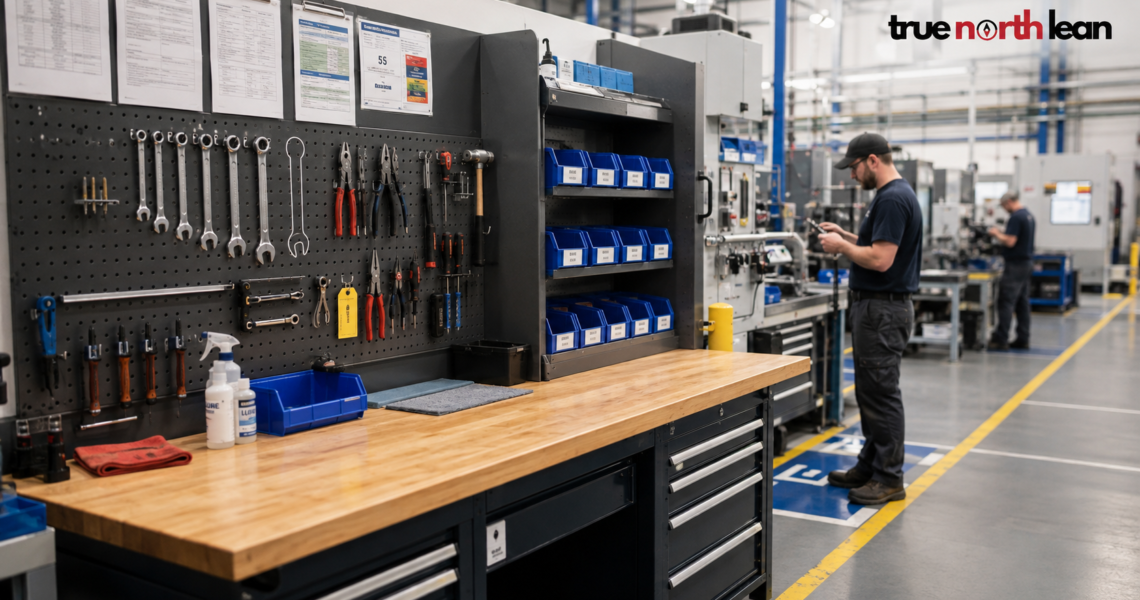
Seiton (Set in order). Organize items so they are easy to access. What is used often should be within reach. What is used rarely should still have a known home. If a new person cannot find a tool in thirty seconds, the layout is wrong.
Seiso (Shine). Clean and inspect the workspace. Cleaning is the inspection. When an operator wipes down a machine every day, they notice the loose bolt, the worn belt, and the fresh oil stain long before those things become a breakdown.
Seiketsu (Standardize). Create rules for the first three steps. Who does what, how often, and to what standard. Without this, the gains depend on who is on shift.
Shitsuke (Sustain). Build the habit of following the rules. This is the step that decides whether the other four survive.
A simple example
Picture a maintenance store room. Three hundred items on the shelves, no labels, and one person who knows where they all are. When that person is on leave, a twenty-minute repair becomes a two-hour search. The team applies 5S. Half the stock turns out to be obsolete spares for machines sold years ago. What remains is arranged by frequency of use, with shadow boards for the common tools. A weekly checklist keeps it that way. The store room did not just get cleaner. It stopped being a single point of failure.
Case study: a components plant in Pune
A mid-sized auto components manufacturer was losing money on changeovers. Die changes on the press line were taking around ninety minutes against a target of forty-five, and the delay was blamed on the operators.
The team spent a shift observing. Of those ninety minutes, close to thirty-five were spent walking: to the tool crib for spanners, to the far end of the shop for the correct die, and back again for a missing bolt. Nobody was working slowly. They were working in a space that made speed impossible.
The fix was unglamorous. Dies no longer in production were removed from the floor. The rest went onto a trolley system next to the line, color-coded by machine. A shadow board held the exact tools needed for a changeover, so a missing one was visible at a glance. Cleaning and inspection became part of the shift handover, and a one-page standard, written by the operators themselves, described the routine.
Within eleven weeks, average changeover time fell to forty-two minutes. Unplanned stoppages dropped by roughly a third because the daily cleaning routine caught problems early. No new equipment was purchased.
The part everyone skips
There is an old saying that lean practitioners return to again and again: “A place for everything, and everything in its place.”
It sounds like advice for a tidy home. In a factory, a hospital, or an office, it is a statement about respect. When we make it easy for people to do good work, we are telling them their time matters. When we leave them hunting for a tool, we are telling them the opposite, whatever the poster on the wall says.
Sustain fails when 5S is treated as a project with an end date, run by a team from outside. It holds when the people who use the space own the standard and when leaders keep showing up to look.
So here is the honest test. If you walked into your own workplace tomorrow and something was out of place, would anyone notice? And would anyone feel it was theirs to fix?