
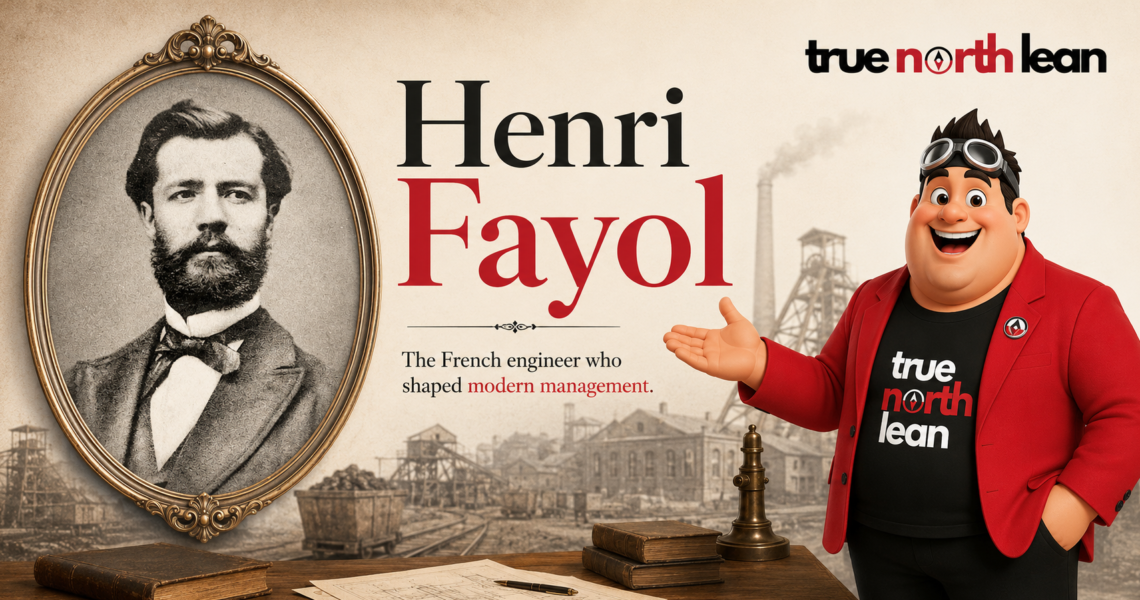
Henri Fayol: The Mining Engineer Who Gave Management Its Grammar
In 1888, the board of a French coal and steel company called Commentry-Fourchambault had more or less decided to give up. No dividend had been paid since 1885. The metallurgical works were losing money. The coal seams at Commentry and Montvicq were running towards exhaustion. The plan on the table was an orderly wind-down: close the plants, mine out what was left, and return whatever remained to the shareholders.
Instead, the board appointed a 47 year old mining engineer as managing director. He asked them for something different. He presented a recovery plan, won their confidence, and stayed for thirty years. By the time Henri Fayol retired in 1918, the company was one of the largest industrial combines in Europe.
What makes Fayol interesting to us at True North Lean is not just that he pulled off the turnaround. It is what he said afterwards about why it worked.
He learned it on the shop floor, not in a lecture hall
Fayol was born in 1841 in a suburb of Constantinople, where his father, a military engineer, was superintendent of works on the Galata Bridge. The family returned to France in 1847. He studied at the École Nationale Supérieure des Mines in Saint-Étienne and graduated as a mining engineer at nineteen. In 1860 he joined the Commentry mine as a junior engineer, and he never worked anywhere else.
By 25 he was running the Commentary mine. Along the way he built a serious scientific reputation, publishing on the spontaneous heating of coal, the formation of coal beds, the sedimentation of the Commentry basin, and plant fossils. He was, on paper, a technical man through and through.
Which is exactly why his conclusion carries weight. Speaking at the International Congress of Mines and Metallurgy in 1900, and later in his writing, Fayol argued that the recovery of his company had very little to do with his skill as a geologist or engineer. He credited his ability to organize and his ability to handle people. The technical work mattered, but it was not the constraint. Administration was the constraint.
That is a familiar realization for anyone who has stood on a gemba and watched a highly capable team lose a day to unclear priorities, duplicated instructions, and decisions that nobody has the authority to make.
What he actually did
The turnaround itself is worth looking at, because it was not a paper exercise. Fayol closed the Fourchambault works, the one operation he judged beyond saving. He kept Montluçon running, at the time the only surviving blast furnace in central France. He pushed Imphy towards special steels, where it became a leader. He solved the coal exhaustion problem by acquiring the Bressac pits in 1891 and the difficult Decazeville field in 1892, and he staffed those recoveries with engineers he had personally trained at Commentry.
Note the pattern. Stop the bleeding, protect the core, and develop capability in people, then invest in the higher-value work. It is close to the sequence we still recommend when a client asks where to begin.
Honest accounting also requires noting that historians have questioned how much credit belongs to Fayol alone. Rising steel prices and stable wages helped. Fayol had good years and good markets alongside good decisions. He would probably not have argued the point too hard, given how careful he was about the limits of his own claims.
The framework
In 1916, Fayol published Administration Industrielle et Générale. It was one of the first attempts anywhere to write down a general theory of management rather than a set of trade-specific tips.
He began by dividing industrial activity into six categories: technical, commercial, financial, security, accounting, and managerial. Naming management as a category alongside the others was the quiet radical move. It said that managing is a body of work in its own right, learnable and teachable, and not just something senior technicians do in their spare time. Fayol argued directly that management should be taught in schools, at a time when nobody was teaching it.
He then defined five functions of management: planning, organizing, commanding, coordinating, and controlling. The word “control” is often misread by English speakers. Fayol’s contrôler is closer to verification than to domination. The manager receives feedback from the process, compares it against what was expected, analyses the deviation, and adjusts. Most modern texts have folded commanding and coordinating together into leading, which is fair enough, but the original five hold up.
His fourteen principles are the part most people remember: division of work, authority and responsibility, discipline, unity of command, unity of direction, subordination of individual interest to the general interest, remuneration, centralization and decentralization, scalar chain, order, equity, stability of tenure of personnel, initiative, and esprit de corps.
Two of them repay a second look.
The scalar chain describes the formal line of authority from top to bottom, and Fayol’s default was that communication should follow it. But he immediately added the “gang plank,” a sanctioned shortcut allowing two people at the same level in different departments to talk directly rather than routing a question up one chain and down another. He built the escape hatch into the design because he had watched what happens to urgent decisions that have to climb five rungs before they can move sideways. Anyone who has mapped an information flow and found six handoffs where two would do will recognize the problem he was solving.
Stability of tenure is the other one. Fayol treated high turnover as an efficiency problem, not just a human resources problem, and he expected management to plan personnel deliberately so that replacements were ready before vacancies opened. Put that next to his principles on initiative and esprit de corps, and a picture emerges that does not fit the caricature of the cold classical theorist.
He was also explicit that these were principles and not laws. They were meant to be applied with judgment, in proportion, according to circumstance.
The line that runs to Lean
Here is the connection that surprises people. Fayol sits in the ancestry of PDCA.
The usual story is that Deming taught PDCA to the Japanese in 1950. He did not. What Deming brought was the Shewhart cycle, a product-focused wheel of design, manufacture, sell, and research. The four-step cycle we now recite was assembled inside Japan over the following decade, principally by Shigeru Mizuno and later named by Kaoru Ishikawa in 1964.
And what those Japanese scholars did was merge two distinct traditions. One was the quality tradition from Shewhart and Deming, which supplied the scientific rigour and the statistical grounding. The other was the management process tradition, which supplied the idea that management is a continuous circular activity rather than a straight line you complete once. Fayol is named in that second tradition, alongside Alvin Brown, William Newman, and Joseph Juran.
So when a team leader stands at a board and works through plan, do, check, act, part of what they are using came from a French mining executive who identified planning and controlling as core management functions in 1916.
The criticism, and why it does not settle the matter
In 1973, Henry Mintzberg dismissed the classical functions as folklore. His research on how managers actually spend their days found something fragmented and interrupted, nothing like the reflective planner Fayol describes. Managers, he argued, occupy roles rather than perform functions.
The critique landed, and it should be taken seriously. But the useful resolution, offered by later scholars, is that the two men were answering different questions. Mintzberg described management as it is. Fayol described management as it ought to be. A standard is not invalidated by the observation that reality departs from it. That gap is precisely what improvement work exists to close.
Fayol never claimed to have produced a finished system. He offered a vocabulary and a starting discipline, and he asked that they be tested in practice rather than accepted on authority. A century on, that remains the right way to use him.