
Lean Manufacturing in Indian SMEs: The Real Barriers Behind a Growing Movement
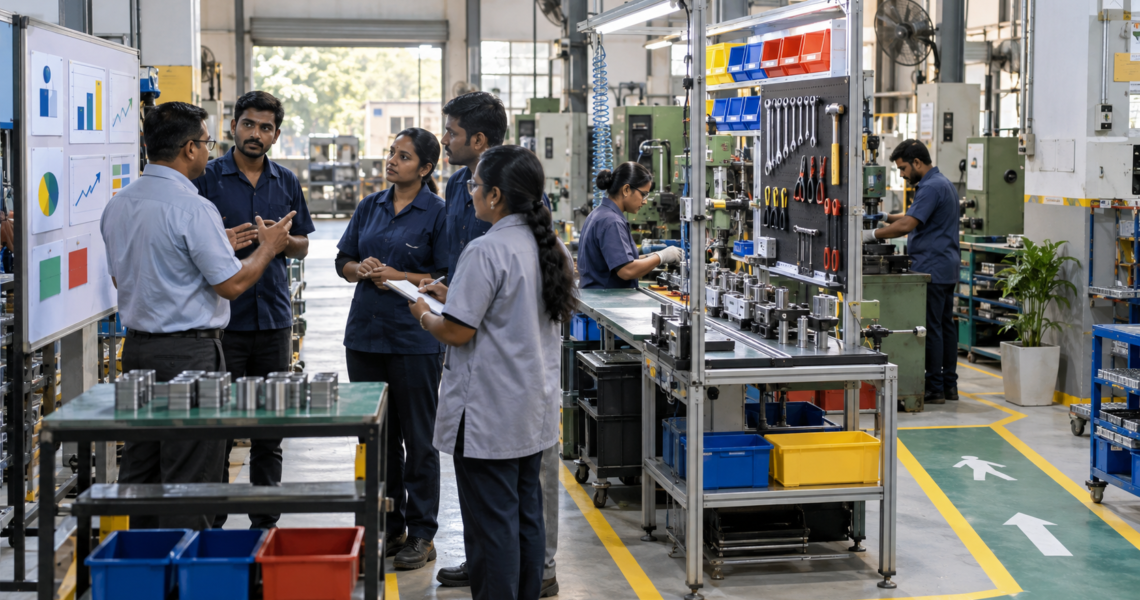
Walk into most Indian small and medium-sized manufacturing units today, whether in automotive components, textiles, or metal fabrication, and you’ll likely hear the word “lean” somewhere on the shop floor. It might be a 5S chart taped to a wall, a supervisor mentioning a Kaizen event, or a manager talking about cutting down work-in-progress. Lean manufacturing has clearly arrived in India’s SME landscape. What’s less clear, even now, is whether it has truly taken root.
That’s the question worth asking in 2026, because the gap between adopting lean tools and actually sustaining them remains as wide as ever for many small manufacturers.
A Familiar Set of Barriers
Talk to enough SME owners and plant managers, and the same handful of obstacles come up again and again. Resource constraints top the list. Most small manufacturers simply don’t have the working capital to invest in dedicated lean consultants, ongoing training, or the equipment upgrades that some improvements require. Cultural resistance is close behind. Workers who have done a job the same way for years, sometimes decades, understandably question why they should change, especially when nobody has clearly explained what’s in it for them.
Skill gaps compound both problems. A single workshop on value-stream mapping doesn’t build the internal capability needed to sustain daily 5S audits or standardized work reviews. And infrastructural support, from reliable power to basic digital tracking systems, is still patchy across many industrial clusters, particularly outside India’s larger manufacturing hubs.
None of this is surprising to anyone who has spent time on an Indian SME shop floor. What’s notable is how consistent these findings are across sectors. Whether it’s a textile unit in Tiruppur or a metal fabrication shop in Ludhiana, the pattern of struggle looks remarkably similar.
Where the Numbers Get Interesting
When lean tools are actually implemented properly, the results tend to be genuinely strong. Simulation-based process modeling across a sample of Indian SMEs has shown average cycle time reductions of around 18 percent and work-in-progress reductions of about 12 percent after targeted interventions like 5S and Kaizen events. Those are not marginal gains. For a small manufacturer running on thin margins, an 18 percent cut in cycle time can be the difference between winning and losing a contract with a larger OEM customer.
The catch, and it’s a significant one, is that these gains only show up where implementation goes beyond a one-time consultant visit. The single biggest predictor of whether lean sticks isn’t the tool chosen. It’s whether top management stays committed once the initial enthusiasm fades and the daily grind of maintaining discipline sets in.
The Government Steps In
The most meaningful development in recent years has been institutional support. The Ministry of Micro, Small and Medium Enterprises now runs a Competitive LEAN Scheme that covers up to 90 percent of implementation costs for eligible units, with an added incentive for clusters owned by women, Scheduled Castes, or Scheduled Tribes, and those located in the northeast. The scheme rolls out in phases, basic, intermediate, and advanced, and requires participating businesses to sign a formal LEAN Pledge before they begin.
That pledge might sound like a formality, but it’s actually a smart bit of design. As one Lean consultant working across Indian manufacturing clusters put it, “Subsidies can pay for the training, but they can’t sign the pledge for the owner. It forces a decision that used to get postponed indefinitely.” In other words, the scheme is trying to solve the commitment problem, not just the funding problem.
What Sustains Lean, and What Doesn’t
If there’s one lesson worth taking from this landscape, it’s that lean manufacturing in Indian SMEs succeeds or fails on people, not tools. Financial subsidies remove one obstacle. They don’t remove the harder work of training a workforce, communicating openly about why change is happening, and involving employees early enough that they see lean as making their job easier rather than threatening it.
Digital tracking is starting to help close that gap too. More SME clusters are now pairing basic 5S and Kaizen efforts with simple dashboards and low-cost sensors that show real-time work-in-progress, replacing paper Kanban boards. As one plant manager described it, “The old system told us what should be happening. The dashboard tells us what’s actually happening. That difference builds trust on the floor.”
For Indian manufacturing SMEs facing tighter export-quality expectations and rising competition, lean is no longer optional. The tools work. The real challenge, now as much as ever, is building the discipline and leadership commitment to keep them working long after the initial rollout ends.
About the Author
Mr. Vijay Allaham is the Founder and Managing Director of True North Lean, a Lean and Kaizen consulting firm working with manufacturers and businesses across India and South Asia. Through hands-on consulting, training, and transformation programs, True North Lean helps organizations build lasting continuous improvement cultures rather than one-off process fixes.